Infrastructure from Code
No Terraform, no CloudFormation, no YAML. Your application code defines what infrastructure exists. Add a database in code, it appears in the cloud.
- ✓Type-safe infrastructure primitives
- ✓Automatic provisioning in AWS or GCP
- ✓Production-grade managed services
- ✓Zero configuration drift
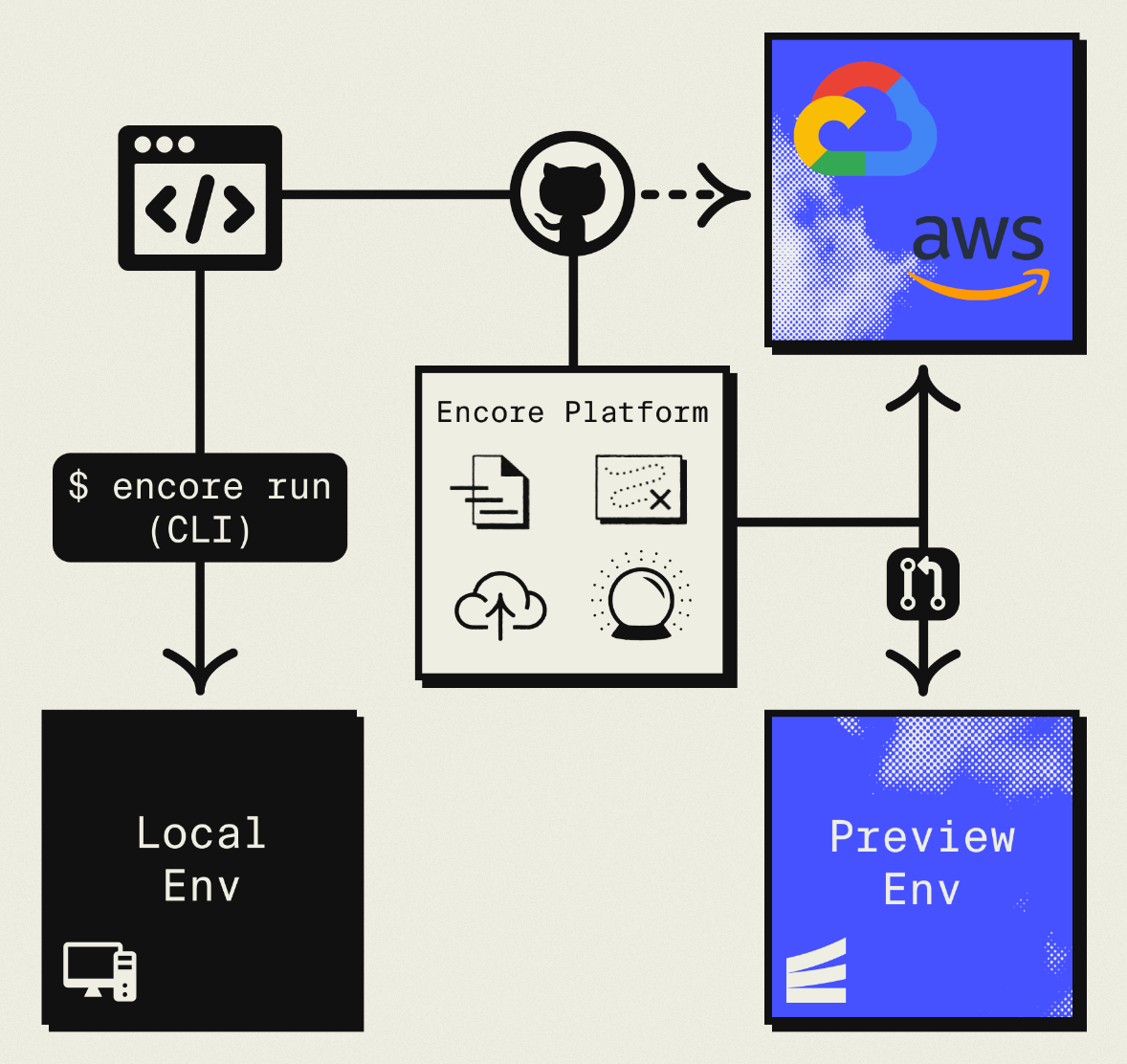
Code is the source of truth
No Terraform, no CloudFormation, no YAML. Your application code defines what infrastructure exists. Add a database in code, it appears in the cloud.
Production-grade services
RDS, Cloud SQL, SNS/SQS, Pub/Sub, S3, Cloud Storage. Battle-tested managed services with proper networking, security, and scaling.
Your cloud account
All resources run in your AWS or GCP account. Full console access, no vendor lock-in for your data or infrastructure.
Your cloud account, your data
All infrastructure runs in your own AWS or GCP account. You have full access to the cloud console, can inspect any resource, and there's no vendor lock-in for your data.
Encore connects to your cloud using a dedicated IAM role with minimal permissions. You can see exactly what Encore creates and modify resources directly if needed.
- ✓Resources in your AWS/GCP account
- ✓Full console access to all resources
- ✓Export and migrate anytime

3 lines for a database
Declare a database in your code. Encore provisions PostgreSQL with migrations, connection pooling, IAM authentication, and proper networking.
Works locally without Docker configuration. Same code deploys to RDS on AWS or Cloud SQL on GCP without changes.
import { SQLDatabase } from "encore.dev/storage/sqldb";

// Encore provisions PostgreSQL in your cloud
const db = new SQLDatabase("users", {
  migrations: "./migrations",
});

// Use with full type safety
const user = await db.queryRow`
  SELECT * FROM users WHERE id = ${id}
`;
Encore vs Terraform
Define infrastructure in your application code instead of separate configuration files.
Encore
Recommendedimport { SQLDatabase } from "encore.dev/storage/sqldb";
const db = new SQLDatabase("users", {
migrations: "./migrations",
});Terraform
resource "aws_db_instance" "users" {
  identifier        = "users-db"
  engine            = "postgres"
  instance_class    = "db.t3.micro"
  allocated_storage = 20
  db_name           = "users"
  username          = var.db_username
  password          = var.db_password
  vpc_security_group_ids = [
    aws_security_group.rds.id
  ]
  # ... plus networking, IAM, secrets
}Cloud Primitives
Encore provides type-safe APIs for the building blocks of modern applications. Under the hood, it uses production-grade managed services from your cloud provider.
SQL Databases
Managed PostgreSQL with automatic migrations, connection pooling, and IAM authentication
RDSCloud SQLPub/Sub Messaging
Event-driven messaging with type-safe topics, automatic retries, and dead-letter queues
SNS + SQSPub/SubCron Jobs
Scheduled tasks with distributed execution and built-in monitoring
EventBridgeCloud SchedulerObject Storage
Blob storage with streaming uploads, signed URLs, and bucket policies
S3Cloud StorageSecrets
Encrypted storage for API keys and credentials, versioned and environment-scoped
Secrets ManagerSecret ManagerCaching
Redis-compatible in-memory cache with cluster mode and automatic failover
ElastiCacheMemorystore