
 Ivan Cernja
Deploying to Google Cloud Platform in 2026 offers several paths, from manual console configuration to fully automated infrastructure-as-code. The right approach depends on your team's size, experience, and what you're building.
This guide covers the main options for deploying backend applications to GCP, with trade-offs, code examples, and recommendations.
Option 1: GCP Console (Click-Ops)
The Google Cloud Console is where most developers start. You navigate through the UI, configure services, and deploy manually.
When it works:
- Learning GCP concepts
- Quick experiments and prototypes
- One-off tasks
When it doesn't:
- Reproducible environments (staging, production)
- Team collaboration
- Compliance and audit requirements
Like any cloud console, it's fine for learning but doesn't scale. There's no version control, no review process, and no easy way to replicate what you built.
Option 2: Infrastructure from Code (Encore)
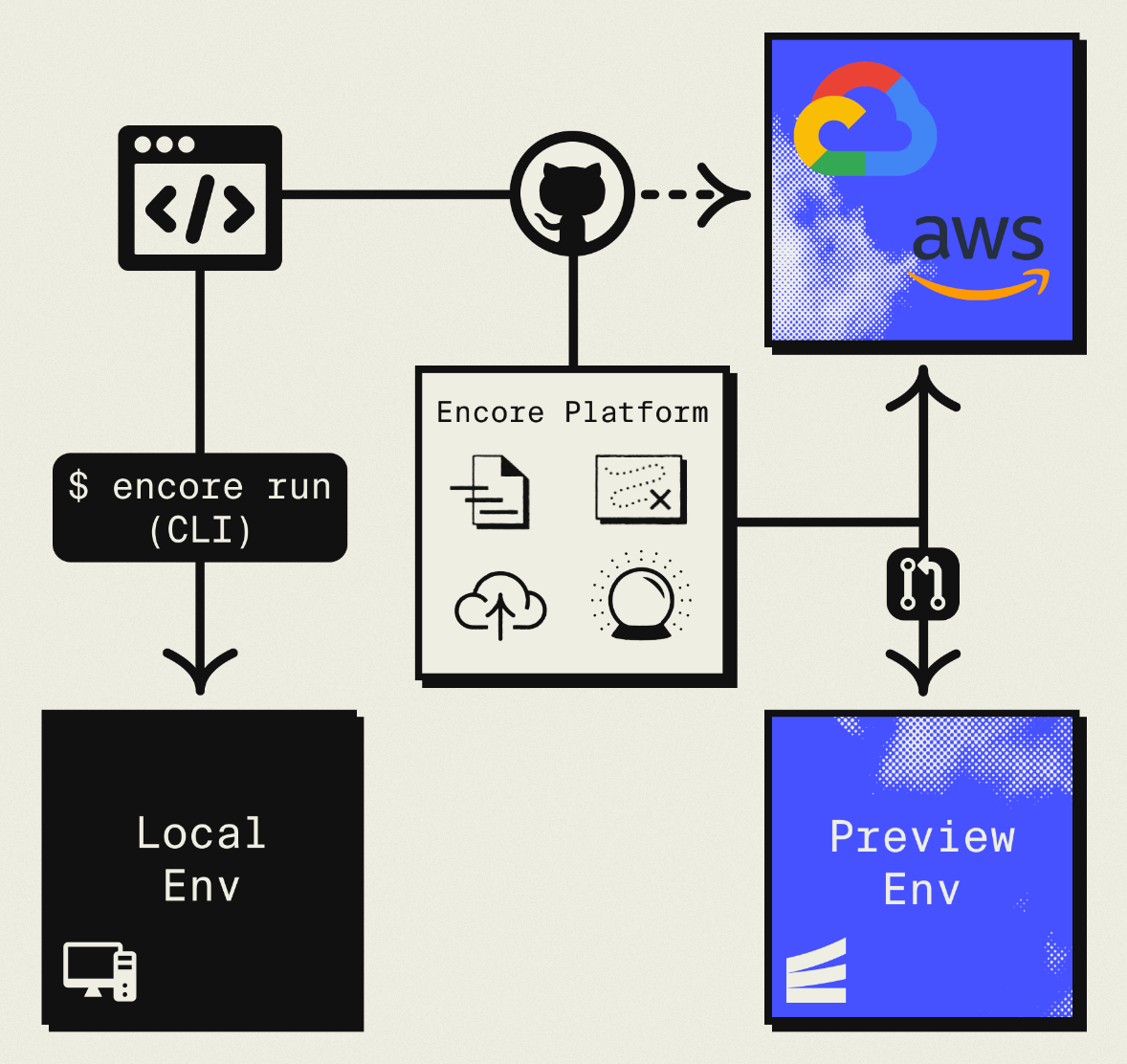
Encore takes a different approach than traditional infrastructure-as-code. Instead of writing separate infrastructure definitions, you declare what your application needs directly in your backend code. Encore Cloud then provisions GCP resources automatically.
import { api } from "encore.dev/api";
import { SQLDatabase } from "encore.dev/storage/sqldb";
import { Topic } from "encore.dev/pubsub";

// This creates a Cloud SQL PostgreSQL database
const db = new SQLDatabase("users", {
  migrations: "./migrations",
});

// This creates GCP Pub/Sub
const signups = new Topic<SignupEvent>("signups", {
  deliveryGuarantee: "at-least-once",
});

// This deploys to Cloud Run
export const createUser = api(
  { method: "POST", path: "/users", expose: true },
  async (req: CreateUserRequest) => {
    const user = await db.exec`INSERT INTO users ...`;
    await signups.publish({ userId: user.id });
    return user;
  }
);
When you push code, Encore analyzes it and provisions the corresponding GCP resources: Cloud SQL for databases, GCP Pub/Sub for messaging, Cloud Run for compute, Cloud Storage for objects, Cloud Scheduler for cron jobs.
What you get:
- No Terraform or Deployment Manager to write
- Infrastructure changes through code review
- Local development with Docker-based versions of GCP services
- Preview environments for every pull request
- Built-in observability (tracing, metrics, logs)
Trade-offs:
- Less granular control over resource configuration than raw Terraform
- Newer ecosystem than Terraform
Encore works well for teams that want GCP infrastructure ownership without becoming infrastructure experts. Companies like Groupon use this approach to power their backends at scale. The open-source framework has 11k+ GitHub stars.
Option 3: Google Cloud Deployment Manager
Deployment Manager is GCP's native infrastructure-as-code service. You define resources in YAML or Jinja2/Python templates.
resources:
- name: my-database
  type: sqladmin.v1beta4.instance
  properties:
    region: us-central1
    databaseVersion: POSTGRES_15
    settings:
      tier: db-f1-micro

- name: my-function
  type: cloudfunctions.v1.function
  properties:
    location: us-central1
    runtime: nodejs18
    entryPoint: handler
    sourceArchiveUrl: gs://my-bucket/function.zip
What you get:
- Native GCP integration
- No third-party dependencies
- Preview deployments before applying
Trade-offs:
- Verbose YAML syntax
- Limited community compared to Terraform
- GCP-only
- Less actively developed than other options
Deployment Manager works but hasn't seen the same investment as Terraform or even CloudFormation. Most teams choose Terraform instead.
Option 4: Terraform
Terraform is the industry standard for infrastructure-as-code and works well with GCP. It uses HashiCorp Configuration Language (HCL).
// Terraform HCL syntax
provider "google" {
  project = "my-project"
  region  = "us-central1"
}

resource "google_sql_database_instance" "main" {
  name             = "my-database"
  database_version = "POSTGRES_15"
  region           = "us-central1"

  settings {
    tier = "db-f1-micro"
  }
}

resource "google_cloud_run_service" "api" {
  name     = "my-api"
  location = "us-central1"

  template {
    spec {
      containers {
        image = "gcr.io/my-project/my-api:latest"
        env {
          name  = "DATABASE_URL"
          value = google_sql_database_instance.main.connection_name
        }
      }
    }
  }
}
What you get:
- Multi-cloud support (AWS, Azure, GCP)
- Massive ecosystem
- State management for tracking deployments
- Plan/apply workflow for reviewing changes
- Large community and documentation
Trade-offs:
- Learning HCL
- State file management complexity
- Separate from application code
Terraform is a popular choice for GCP infrastructure-as-code, particularly for teams that need multi-cloud support. The trade-off is maintaining a separate codebase for infrastructure.
Option 5: Pulumi
Pulumi lets you write infrastructure-as-code in real programming languages instead of HCL or YAML.
import * as pulumi from "@pulumi/pulumi";
import * as gcp from "@pulumi/gcp";

const database = new gcp.sql.DatabaseInstance("database", {
  databaseVersion: "POSTGRES_15",
  region: "us-central1",
  settings: {
    tier: "db-f1-micro",
  },
});

const service = new gcp.cloudrun.Service("api", {
  location: "us-central1",
  template: {
    spec: {
      containers: [{
        image: "gcr.io/my-project/my-api:latest",
        envs: [{
          name: "DATABASE_URL",
          value: database.connectionName,
        }],
      }],
    },
  },
});
What you get:
- Real programming language (TypeScript, Python, Go)
- Type safety and IDE support
- Multi-cloud support
- Loops, conditionals, functions
Trade-offs:
- Smaller ecosystem than Terraform
- Still requires understanding GCP service configuration
- Separate from application code
Pulumi offers an alternative to Terraform's HCL if you prefer TypeScript, but you still need to understand GCP service configuration.
Option 6: Cloud Run Direct Deployment
For simple containerized applications, Cloud Run offers direct deployment without infrastructure-as-code.
# Build and deploy in one command
gcloud run deploy my-api \
  --source . \
  --region us-central1 \
  --allow-unauthenticated
What you get:
- Simple deployment for containers
- No infrastructure config needed
- Fast iteration
Trade-offs:
- Only covers compute (not databases, queues, etc.)
- No infrastructure version control
- Doesn't scale to complex applications
Cloud Run's direct deployment works for simple services but you'll need something else for databases, Pub/Sub, and other resources.
Comparison
| Approach | Learning Curve | Flexibility | Maintenance | Best For |
|---|---|---|---|---|
| Console | Low | High | None (not repeatable) | Learning, experiments |
| Encore | Low | Medium | Low | Teams wanting GCP without DevOps |
| Deployment Manager | High | High | High | GCP-native requirements |
| Terraform | Medium | Very High | Medium | Multi-cloud, large infra |
| Pulumi | Medium | Very High | Medium | Developers who prefer real code |
| Cloud Run Direct | Low | Low | Low | Simple containerized apps |
Which Should You Choose?
Choose the Console if:
- You're learning GCP
- It's a one-time experiment
Choose Encore if:
- You want to focus on backend code, not infrastructure
- You want GCP ownership without becoming a GCP expert
- You value fast iteration and built-in observability
- Your infrastructure needs are covered by databases, queues, cron, storage
Choose Deployment Manager if:
- Your organization mandates GCP-native tooling
- You can't use third-party tools
Choose Terraform if:
- You need multi-cloud support
- You have complex infrastructure requirements
- Your team has (or wants to build) infrastructure expertise
- You're already using Terraform for other projects
Choose Pulumi if:
- You want Terraform's flexibility with real programming languages
- Your team prefers TypeScript/Python over HCL
Choose Cloud Run Direct if:
- You're deploying a simple containerized app
- You don't need databases or other managed services
Getting Started
Start with the simplest option that meets your needs. If you're building a backend application and don't want to become an infrastructure expert, Encore is worth trying. If you need maximum flexibility or multi-cloud support, Terraform is the industry standard.
Whatever you choose, avoid the console for production workloads. Infrastructure-as-code isn't optional in 2026.
Want to jump straight to a running app? Clone this starter and deploy it to your own cloud.